
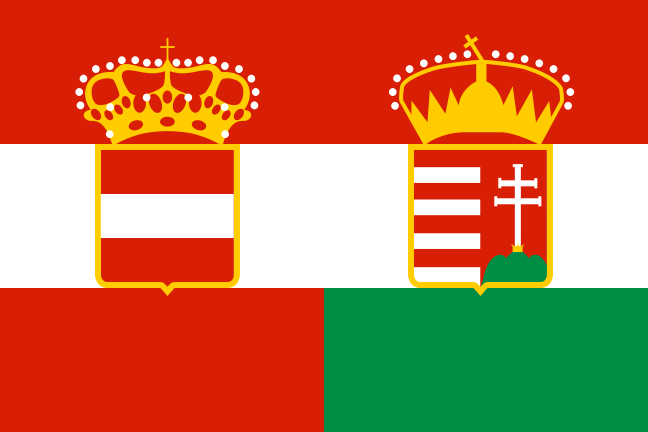
Play as · WW1 1914 · L1 · Dual Monarchy · Agrarian home front
Lands of the Hungarian Crown - 1914
The Lands of the Hungarian Crown enter 1914 as one half of the Dual Monarchy, not an independent foreign-policy actor. Emperor-King Franz Joseph rules through the 1867 Compromise: Vienna manages common diplomacy, war and associated finance, while Budapest controls its parliament, administration and most domestic policy. Prime Minister István Tisza initially warns that war against Serbia may draw in Russia and inflame the monarchy's nationality problem, then supports the ultimatum after receiving assurances that Serbia will not be annexed. Historic Hungary includes Croats, Slovaks, Romanians, Serbs, Ruthenians and Germans alongside Magyars, with restrictive franchise and Magyarization making wartime loyalty a political question. The kingdom supplies grain, horses, rail capacity and a large share of common army manpower. Budapest's elite wants equal influence with Austria but resists changes that might give Slavic peoples comparable standing. The campaign is therefore a home-front statecraft challenge inside an empire: meet common military demands without allowing requisition, casualties and national distrust to make the settlement of 1867 ungovernable.
Starting position
Create a joint mobilization board that gives Hungarian ministries timely railway and supply information instead of letting common commands issue disconnected demands. Harvest labor must be protected through exemptions, prisoner employment under rules, and machinery allocation; grain requisitions set too low will produce urban hunger, while excessive seizures will reduce planting and encourage concealment. Publish burdens by county and language region so officials cannot shift them onto politically weak communities. The Honvéd contributes territorial formations but depends on common artillery, logistics and strategic command. Insist that Hungarian units receive equipment proportional to manpower rather than using the war to build a separate army Vienna will view as disloyal. Parliament should continue meeting and voting extraordinary finance. Expand local-language notices, medical care and military chaplaincy to reduce the sense that mobilization is an ethnic Magyar project. Croatia-Slavonia's constitutional position requires negotiation with Zagreb, not orders routed around the Croatian government. Home-front legitimacy is a military resource the general staff cannot replace.
What turns the campaign
The turn comes as a short punitive campaign becomes a multi-front war. Russian pressure through Galicia exposes northeastern Hungary and creates refugee movements; Serbian resistance consumes forces; Romanian neutrality leaves Transylvania uncertain. Coordinate Carpathian fortification with civilian evacuation plans and rolling-stock reserves rather than improvising after a breakthrough. Tisza can use Budapest's consent over common budgets to demand strategic clarity, but obstruction that paralyzes the army will also endanger Hungary. Consider franchise reform and nationality concessions while the state still bargains from strength. Promising local administration or schools may secure more loyalty than police surveillance, though Magyar elites will resist. Italy's choice and Romania's territorial ambitions should shape force allocation long before either enters the war. Maintain Danube shipping and alternate rail routes for grain. If military authorities impose martial law, attach review dates and civilian appeals. A government that responds to every strike or newspaper criticism as treason will blind itself to real production failures and organized espionage alike.
Signature challenge
The bargain behind the front
Hungary's signature challenge is preserving the Compromise while the common war magnifies everything it leaves unresolved. Budapest demands parity with Vienna yet denies similar bargaining power to many peoples governed from Budapest. NationFall makes that contradiction operational. Romanian communities in Transylvania, Slovaks in the north and Serbs in the south can supply soldiers and taxes, but not indefinitely if schools, land disputes and offices communicate permanent exclusion. Reform risks provoking the parliamentary coalition on which Tisza depends; refusing reform may turn military reverses into movements for separation. Use the kingdom's grain and credit as leverage for competent common command, then spend some of that leverage on a broader domestic settlement. Keep wartime censorship narrow enough that accurate casualty and food information reaches decision makers. Success leaves Hungary capable of negotiating constitutional change from inside a surviving monarchy. Failure protects elite privileges until defeat removes the monarchy and borders together. The strategic objective is not simply to win battles for Vienna; it is to ensure the Hungarian state that pays for them remains politically coherent when Europe redraws itself.
Try the Lands of the Hungarian Crown campaign
Free demo. Keep the Hungarian half of the empire supplied and governable.
Play Free Demo as Lands of the Hungarian CrownRegional: Austria-Hungary · Serbia · Romania
Lands of the Hungarian Crown across the eras