

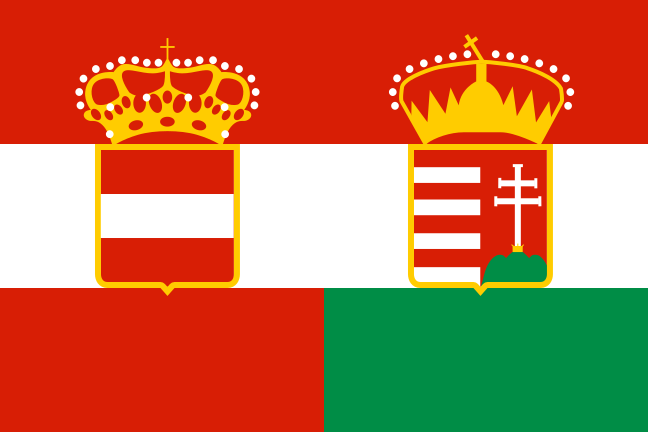
Play as · WW1 1914 · L3 · Central Powers
Austria-Hungary - August 1, 1914
The Dual Monarchy that mobilizes in the last days of July 1914 is the great power that struck the match and the one least able to survive the fire. Fifty-one million subjects across eleven principal nationalities are governed by two parliaments, one army, and an eighty-four-year-old emperor, Franz Joseph, who has reigned since 1848 and outlived his own heir. The quarrel with Serbia that Vienna has chosen to settle by force - the ultimatum, the rejection, the shelling of Belgrade - is the spark that pulls Russia, then Germany, then all of Europe into the general war. The strategic identity is the fragile multinational empire: militarily the weakest of the five great powers, financially the poorest, dependent on Berlin for weight it does not have, and committed to a punitive war in the Balkans at the exact moment it must also hold the long Galician frontier against the Russian army. It is the empire with the most to lose and the least margin to lose it with.
Starting position
The k.u.k. Army that Franz Conrad von Hötzendorf leads to war is a peacetime force of about 450,000 expanding toward three million, organized on paper into a first-line army, a second B-staffel echelon, and a Balkan grouping - and Conrad has never fully decided where the B-staffel belongs. Commands are issued in German but the ranks speak a dozen tongues; regimental cohesion depends on the Regimentssprache and the loyalty of the officer corps to the dynasty rather than to any nation. The artillery is competent, the Skoda heavy howitzers genuinely first-rate, but the army is short of machine guns and its doctrine still favours the offensive spirit over firepower. Diplomatically Vienna enters the war leaning entirely on the German alliance, with the two nominal Triple Alliance partners - Italy and Romania - already signalling that they regard the treaty as defensive and will not march. The immediate problem is geography and arithmetic: a punitive campaign against Serbia in the south, and simultaneously four Russian armies gathering against Galicia in the northeast, with one army's worth of troops too few to do both.
What turns the campaign
What the Monarchy wants is the short, sharp humiliation of Serbia that the July decision promised - Belgrade punished, the South Slav agitation broken, the empire's prestige restored before Russia can intervene in force. It wants Germany to hold the Russians while Vienna finishes in the Balkans, Italy and Romania kept inside the Triple Alliance or at least neutral, Bulgaria brought in against Serbia, and the eleven nationalities kept quiet by the shared discipline of a war the dynasty frames as defensive. What it fears is the war it received: Conrad's forces split between Serbia and Galicia and beaten in both, the Serbian army holding at the Kolubara, the Russian steamroller taking Lemberg and pouring through the Carpathian passes toward the Hungarian plain, and above all the slow internal answer - Czech regiments surrendering, the Poles and Ruthenes and South Slavs measuring their loyalty against the war's cost, and the certainty that a long war will finish the empire from the inside even if the front holds. Every Austro-Hungarian fear is a clock: the dynasty can survive a quick war and not a patient one.
Signature challenge
The two fronts and the eleven nations
Austria-Hungary's central strategic problem is that it must fight two wars at once with the strength for barely one, and hold together eleven nationalities while doing it. Conrad's fatal indecision - whether the B-staffel armies belonged against Serbia or against Russia - meant they spent the opening weeks riding the railways between the two fronts and arriving too late for either, so the Monarchy lost the quick Balkan victory and the Galician defensive line in the same month. Behind the fronts sits the deeper trap: the empire is a dynastic bargain among peoples, and every month of casualties, requisition and defeat converts subjects into nationalists. NationFall surfaces this as the Austro-Hungarian campaign's defining tension: you command a great-power army that cannot actually reach great-power results, tethered to Germany for the weight to matter and to the calendar for survival, because the war that the Monarchy started is the one thing guaranteed to dissolve it. Win fast, keep Germany committed and the nationalities silent - or watch the empire come apart behind a front that still holds.
Try the Austria-Hungary campaign
Free demo. Pick WW1. Pick Austria-Hungary. Win in the Balkans before the empire comes apart behind you.
Play Free Demo as Austria-HungaryRegional: the German Empire · the Ottoman Empire · Russia - see the WW1 1914 scenario hub
Austria-Hungary across the eras