

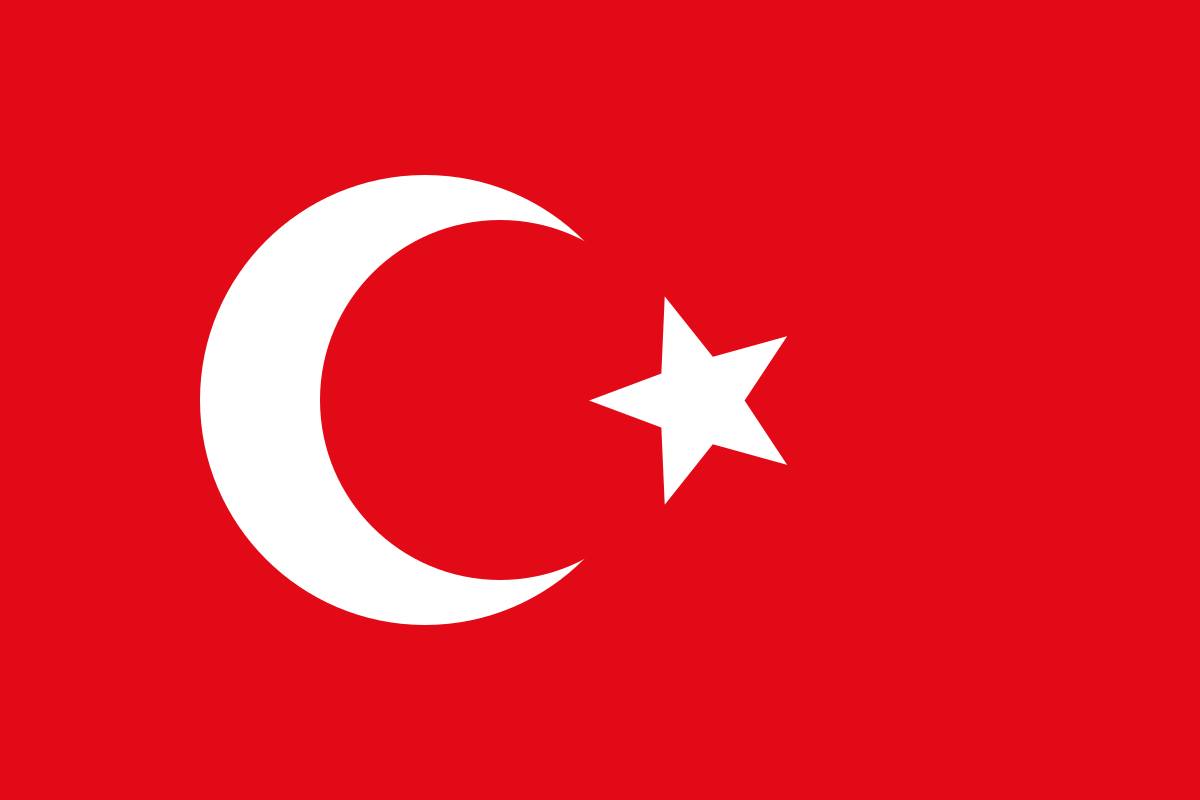
Play as · WW1 1914 · L2 · Central Powers
Ottoman Empire - August 1, 1914
The empire that watches the July Crisis from the sidelines in August 1914 is the one the other powers have already agreed to divide, and the one best placed to change the war anyway. The Ottoman state has spent a decade in retreat - Libya lost to Italy in 1911, almost all of its European territory lost in the Balkan Wars of 1912-13 - and the Young Turk triumvirate around Enver, Talaat and Cemal governs a shaken twenty-three-million-subject empire that every chancellery in Europe expects to inherit. But it sits on the one piece of geography that can decide the eastern war: the Straits at Constantinople, the cork in the bottle of Russia's warm-water trade, and the land bridge from Anatolia toward Suez, the Caucasus and Mesopotamia. On 2 August it signs a secret alliance with Germany; the arrival of the warships Goeben and Breslau gives the bargain teeth. The strategic identity is the declining empire with a decisive card: too weak to defend all its frontiers, strong enough - if it enters at the right moment - to close the Straits and starve an ally out of the war.
Starting position
The Ottoman Army in the summer of 1914 is a force still rebuilding from the Balkan catastrophe, perhaps 800,000 men mobilizable but short of everything modern war consumes - artillery, transport, trained officers, and above all railways, since the Baghdad line is unfinished and much of the empire moves at the pace of the camel and the coastal steamer. A German military mission under Liman von Sanders is reorganizing it, and German credit and weapons are the price and the promise of the new alliance. The empire's assets are positional rather than material: the Dardanelles and Bosphorus, fortified and minable, which can be closed to Russian and Entente shipping; the religious authority of the Caliphate, which Berlin hopes can raise the Muslim subjects of the British and Russian empires; and interior lines across Anatolia that let a small army shuttle - slowly - between threats. The liabilities are just as structural: a Caucasus frontier facing the Russian army, an Egyptian frontier facing the British at Suez, a Mesopotamian coast open to seaborne attack, and Arab and Armenian populations whose loyalty the war will strain to breaking.
What turns the campaign
What the empire wants is to pick the winning side and use the war to reverse a decade of losses - to recover ground in the Balkans and the Caucasus, to break the capitulations and the foreign financial control, to close the Straits and choke Russia's grain and munitions trade, and to raise a holy war that turns Britain's and Russia's Muslim subjects against them. It wants German guns, gold and expertise, a moment of entry chosen for maximum effect rather than forced by events, and Bulgaria alongside it to link Constantinople to Berlin by land. What it fears is the standing plan of the Entente powers to partition it outright - Constantinople and the Straits promised to Russia, the Arab lands eyed by Britain and France - and the military reality that it cannot hold the Caucasus, Sinai and Mesopotamia at once against enemies who can strike by sea wherever they choose. The empire's survival depends on turning one decisive advantage into leverage before its many weak frontiers are pried open one at a time.
Signature challenge
The Straits and the moment of entry
The Ottoman Empire's central strategic problem is that it holds a war-deciding asset and a nearly indefensible perimeter at the same time, and everything turns on how it plays the gap between them. Closing the Dardanelles severs Russia from its Western allies - no other single act on the board so directly starves a great power - which is why the empire's alliance with Germany is worth far more than its army suggests. But the same empire cannot simultaneously defend the Caucasus against Russia, Sinai against Britain, and Mesopotamia against a landing, and its railways are too thin to move reserves fast enough to try. NationFall surfaces this as the Ottoman campaign's defining tension: you command a state everyone has written off, holding the one chokepoint that can decide the eastern war, and you must convert that leverage into survival before your open frontiers and your creditors finish the partition the great powers have already sketched. Shut the Straits, raise the frontiers, and make the empire indispensable to Berlin - before it is dismembered by the alliance it chose to defy.
Try the Ottoman Empire campaign
Free demo. Pick WW1. Pick the Ottoman Empire. Close the Straits and make a written-off empire decisive.
Play Free Demo as Ottoman EmpireRegional: Austria-Hungary · the German Empire · the Russian Empire - see the WW1 1914 scenario hub
Ottoman Empire across the eras