

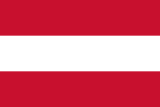
Play as · Cold War 1947 · L1 · Four-Power Occupied
Austria - 1947
Austria in 1947 is occupied like Germany but not treated like it - a distinction that is the whole of its strategy. Under the Moscow Declaration of 1943 the Allies called Austria the first victim of Nazi aggression rather than a defeated enemy, and so, although American, British, French and Soviet forces occupy the country and divide Vienna into four sectors with an international zone at its heart, Austria has something Germany does not: a single national government, led by Chancellor Leopold Figl, recognised by all four occupying powers. The red-white-red flag flies throughout the occupation. The country is poor, hungry and split into zones whose economies pull apart, and the Soviet zone's industries are being milked as 'German assets'. But Austria's institutions are intact and legitimate, and its politics are firmly non-communist - the 1945 elections routed the left. The strategic identity is the occupied nation that kept its statehood: a small country threading between four armies and two blocs, trying to talk its way to a treaty and out the door.
Starting position
The starting board is a functioning state under four-power occupation. The government in Vienna administers the whole country on paper, but every zone answers to a different occupier, and the Allied Council can veto its laws. Vienna itself, deep inside the Soviet zone, is patrolled by the famous inter-Allied patrols - the 'four men in a jeep' - and its international sector is a listening post of the early Cold War. The economy is fragile and dependent: the 1947 harvests are poor, rationing is tight, and the country will lean heavily on Marshall aid, which the government moves to accept, aligning it economically with the West even as Soviet troops sit on its soil. Negotiations for an Austrian State Treaty that would end the occupation have begun and will drag on for years, snagged on the German-assets question and the wider East-West freeze. Austria holds almost no hard power - its military is nascent under occupation - but it holds legitimacy, unity and a clear popular tilt toward the West.
What turns the campaign
What Vienna wants is simple to state and hard to achieve: the departure of all four armies, a state treaty that restores full sovereignty, and the preservation of Austrian unity and independence between the blocs. The obstacle is that Austria is hostage to the larger East-West quarrel - its treaty will not be signed until the two sides find it convenient, and until then Soviet troops and Soviet economic demands remain. The levers are the country's recognised government and popular legitimacy, which deny either bloc a pretext to install a puppet; Marshall aid and Western sympathy, which anchor recovery; and the patient diplomacy of neutrality - the promise, eventually made explicit, that a free Austria will join neither camp. The fears are partition on the German model, a communist coup attempt in the Soviet zone, and endless occupation. The campaign turns on keeping the country whole and its government legitimate while accepting Western economic help without provoking the Soviets - buying survival and unity year by year until the great powers agree to let a neutral Austria go.
Signature challenge
Occupied, but still a state
Austria's central strategic condition in 1947 is that it is occupied by four armies yet remains a single, legitimate state - and that difference from Germany is the seam it must work. Where Germany has no government and is drifting toward permanent division, Austria has a recognised administration, a national flag over every zone, and a population that has already chosen against communism at the ballot box. NationFall surfaces this as the campaign's defining tension: a tiny, powerless country that survives not by force - it has almost none - but by legitimacy, unity and the patience to outlast an occupation, refusing to become either bloc's prize while accepting the help it needs from one of them. The player inherits no meaningful hard power and one precious asset: a state the occupiers all recognise and none can easily replace. Whether Austria holds together and talks its way to the neutral independence history eventually granted it in 1955, or is torn along the German fault line into a divided country, is being decided in these years of four-power occupation, and the campaign puts that quiet survival in the player's hands.
Try the Austria campaign
Free demo. Pick Cold War. Pick Austria. Keep a nation whole between four armies.
Play Free Demo as AustriaRegional: Occupied Germany · Italy · Yugoslavia to the south - see the Cold War 1947 scenario hub
Austria across the eras