

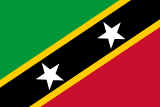
Play as · WW3 2026 · L1 · Two-island federation · CBI reformer
Saint Kitts and Nevis - 2026
Saint Kitts and Nevis enters the 2026 scenario as a very small sovereign federation whose size magnifies every external rule change. Prime Minister Terrance Drew leads the federal government from Basseterre, while the Nevis Island Administration exercises constitutionally protected autonomy across the Narrows. The arrangement is not decorative: spending, land, tourism and political loyalty can look different on the two islands, and the constitution contains an exceptional route by which Nevis could seek separation. Sugar production ended in 2005 after centuries of plantation dominance, leaving tourism, construction, services and citizenship-by-investment revenue to carry much of the adjustment. The federation maintains diplomatic relations with Taiwan and participates in the OECS, CARICOM, the Eastern Caribbean currency union and the Regional Security System. Its strategic identity is therefore not simply the smallest state in the hemisphere. It is a two-island constitutional bargain trying to replace one monoculture while international partners scrutinize the programme that financed much of the transition.
Starting position
The Saint Kitts and Nevis Defence Force, coast guard, police and regional partners provide a small security establishment focused on maritime surveillance, disaster response and internal support rather than conventional deterrence. Ports, the Robert L. Bradshaw airport and tourism properties create concentrated infrastructure targets. Hurricanes, water scarcity, cyber disruption or one failed correspondent-banking relationship can impose national costs. Fiscal policy begins with the citizenship programme. Saint Kitts and Nevis pioneered the model in 1984, but longevity does not immunize it from European visa pressure, due-diligence demands or reputational shocks. Drew's government has publicly argued for reducing reliance on CBI through a Sustainable Island State agenda while participating in an Eastern Caribbean regulatory framework. Treat that as a direction, not a completed diversification. Publish programme inflows, long-term obligations and project performance; fund recurrent services from durable revenue rather than a volatile application cycle. Coordinate federal investments with Nevis openly, because opaque allocation turns every external shock into an internal constitutional grievance.
What turns the campaign
The campaign turns on converting temporary financial leverage into assets that lower permanent vulnerability. Geothermal development on Nevis could supply dependable renewable electricity and perhaps support regional energy exchange, but drilling risk, financing, transmission and island revenue-sharing must be agreed before announcements become savings. Solar, storage and grid hardening can produce earlier gains. Tourism strategy should protect beaches, water and local access while moving more food, maintenance and professional services into domestic supply chains. Taiwan cooperation offers agriculture, health, education and technology projects; judge each by measurable delivery while preserving a diplomatic position both islands support. In CARICOM, bargain for cheaper maritime freight, food security and disaster finance rather than expecting national scale to solve logistics. Security investment belongs in radar, coast-guard readiness, interoperable communications and shelters. CBI reform remains the hinge: strong verification and regional minimum standards may reduce application volume, yet weak enforcement risks the visa-free mobility on which citizens and tourism depend. The choice is between credible smaller revenue and an apparently larger stream whose acceptance can vanish abroad.
Signature challenge
Two balance sheets, one passport
The defining challenge is keeping the federal bargain legitimate while rebuilding the public balance sheet around less CBI dependence. Applications produce federal revenue, but residents experience results through water, electricity, health care, housing, roads and island-level institutions. Create a published stabilization fund separating windfalls from normal spending. Disclose beneficial ownership, rejected applications and procurement outcomes without compromising personal security. Give the Nevis Island Administration predictable transfers and a formal role in projects that create liabilities for the whole federation. At the same time, improve tax administration and private investment so reform does not mean abrupt austerity for households least responsible for dependence. A successful 2026 campaign preserves international mobility and Taiwanese ties, advances energy resilience, keeps debt manageable and makes continued union visibly worthwhile on both islands. Failure can come from opposite directions: defending every old programme practice until partners impose consequences, or closing revenue faster than replacement sectors mature. NationFall rewards a government that treats sovereignty as the capacity to accept stricter rules on its own transparent terms, then converts the breathing room into an economy able to survive when passport demand falls.
Try the Saint Kitts and Nevis campaign
Free demo. Regulate the original CBI programme, harden two islands, and keep the federation worth choosing.
Play Free Demo as Saint Kitts and NevisRegional: Antigua and Barbuda · Dominica
Saint Kitts and Nevis across the eras
Saint Kitts and Nevis (WW1) · Saint Kitts and Nevis (WW2) · Saint Kitts and Nevis (Cold War)