

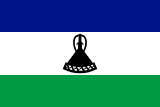
Play as · WW3 2026 · L1 · Mountain Kingdom · South Africa-Surrounded
Lesotho - 2026
Lesotho is a sovereign enclave entirely surrounded by South Africa, a constitutional monarchy under King Letsie III with executive authority held by Prime Minister Sam Matekane of the Revolution for Prosperity party since the October 2022 election. Population is about 2.3M and GDP about $5B PPP. The strategic identity is the enclave Mountain Kingdom: its lowest point is more than 1,400 metres above sea level, and the South African Customs Union, migrant labour and Highlands Water Project bind its economy to its only neighbour. Vatican City and San Marino are also sovereign enclaves, so Lesotho's distinction comes from its African mountain geography and complete dependence on one surrounding state rather than an inaccurate claim to be the world's only example.
Starting position
The Lesotho Defence Force is about 2,000 active personnel, oriented toward border defense (effectively the South African boundary, with its specific dynamics), internal security, and limited regional-cooperation deployments. Equipment is light. The Lesotho Highlands Water Project - the multi-decade infrastructure cooperation that delivers Senqu/Orange-River-basin water from Lesotho's mountains to the Gauteng industrial heartland of South Africa - is the principal strategic-economic asset, with continuing royalty and water-sales revenue that has substantially funded the Lesotho fiscal architecture. The AGOA textile-export economy (substantial pre-2024 employment, the post-AGOA-renewal-question continuing political-economic challenge) and the labor-migration remittances from South African employment are the secondary economic pillars.
What turns the campaign
What Lesotho under Matekane wants is the post-2022-election reformist agenda institutionalized through the legislative-and-administrative framework that the new administration has begun, the Lesotho Highlands Water Project Phase 2 (the Polihali Dam and the broader Phase 2 infrastructure) operationalized at the projected timeline, the AGOA preferences renewed through the post-2025 framework that the US Congress has been considering, the South African Customs Union and broader bilateral economic relationship preserved against any periodic stress, and the political-institutional continuity preserved through the next election cycle (the 2027 election will be the test of the post-Matekane political-institutional consolidation). What Lesotho fears is a South African political-economic crisis that produces spillover effects on the labor-migration and Customs Union frameworks, an AGOA non-renewal that hollows the textile-export sector, a domestic political-institutional crisis on the post-2014-coup pattern, and a major drought event that disrupts the Highlands Water Project flows.
Signature challenge
The enclave kingdom
Lesotho's central strategic problem is sustaining sovereign functions within an enclave whose external trade, transport and major infrastructure run through South Africa. The post-2022 Matekane reform agenda is the most substantive recent political change; the underlying geographic premise has persisted since 1966. NationFall surfaces a mountain kingdom whose continuity depends on cooperation with a single neighbour undergoing its own political and economic strain. Use the Highlands Water Project as leverage and obligation: protect royalty revenue through public accounts, fund communities affected by reservoirs, and enforce dam safety while negotiating the next construction phase with Pretoria. Textile employment requires reliable electricity, customs clearance and market access beyond one preference scheme. Create retraining and small-enterprise credit before factories close. Security reform must place the defence force under civilian command and prevent coalition disputes from becoming barracks interventions. Parliament should complete constitutional rules for government formation, no-confidence votes and appointments. Mountain roads, clinics and digital links reduce the political distance between Maseru and highland districts. Sovereignty becomes credible when a snowbound village receives services and when a South African ministry knows every water or border agreement will survive Lesotho's next coalition change. Prepare drought and snow plans with district food depots instead of assuming South African roads always remain open. Make water royalties visible in those depots, local bridges and rural health posts. Negotiate migrant-worker pensions and cross-border emergency care as treaty rights. The police and army need distinct commands, transparent promotion and parliamentary budgets so political factions cannot recruit institutions into private struggles. Coalition leaders should publish agreements and cost them before taking office. A constitutional monarchy can steady transfers only when royal intervention follows written rules. These practical safeguards turn dependence into managed interdependence and give every government incentives to preserve the same system.
Try the Lesotho campaign
Free demo. Pick WW3. Pick Lesotho. Enclave kingdom. Mountain country. The South Africa surround.
Play Free Demo as LesothoRegional: South Africa · Eswatini
Lesotho across the eras