
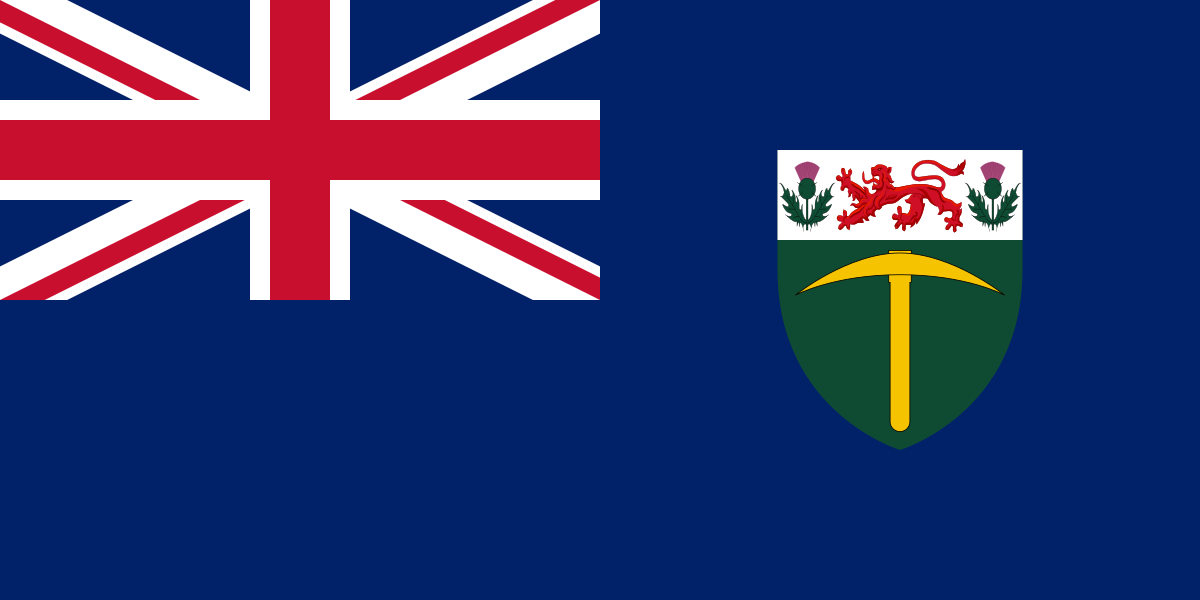
Play as · WW2 1939 · L1 · Self-Governing Colony
Southern Rhodesia - September 1, 1939
Southern Rhodesia in 1939 is the anomaly of British Africa: a colony that governs itself. Since 1923, when its white electorate voted against joining South Africa and for responsible government instead, the territory has had its own prime minister, its own legislature and control of almost everything except foreign affairs and a rarely-used imperial veto over African matters. It is not a Crown Colony run from London and it is not a Dominion - it is a self-governing settler state in a category of its own, built by the British South Africa Company's pioneers and now run by and for its roughly sixty thousand whites. Prime Minister Godfrey Huggins presides over a prosperous economy of tobacco, gold and maize, a growing settler population, and a body of segregationist law - the Land Apportionment Act above all - that reserves the best land and the political nation for Europeans while an African majority of well over a million is governed, taxed and excluded. The strategic identity is the settler colony with a state of its own: self-confident, ambitious, and already thinking beyond its borders toward the amalgamation of the Rhodesias it will spend the next two decades pursuing.
Starting position
The starting board is a self-governing colony with the institutions of a small state and the racial order of a settler one. Southern Rhodesia has its own armed forces in embryo - a defence establishment, the Rhodesia Regiment lineage, an air unit that will feed pilots and aircrew into the imperial war effort in numbers wildly disproportionate to its size. The economy stands on tobacco, the gold mines that first drew the settlers, maize and cattle, and the industrial beginnings that the coming war will accelerate; the railway ties it to the Northern Rhodesian Copperbelt above and the South African ports below. Politically it is a functioning parliamentary democracy for its whites and an administered subject population for everyone else: the Land Apportionment Act of 1930 has legally partitioned the country by race, African wages and movement are controlled, and the settler legislature guards its autonomy jealously against both London and Pretoria. Society is the settler pyramid in its purest local form - a European minority holding the franchise, the land and the skilled economy, over an African majority confined to reserves and labour. The pieces are the self-governing institutions, the tobacco-and-gold economy, the disproportionate military contribution and the segregation code underwriting all of it.
What turns the campaign
What Salisbury wants is to defend and extend its autonomy: to run its own affairs without imperial interference, to protect the settler order the Land Apportionment Act codifies, and to press its long ambition of amalgamating with Northern Rhodesia to secure the Copperbelt's wealth and enlarge the settler state. What the war offers is a chance to prove the colony's worth to the empire and bank the credit. Southern Rhodesia throws itself into the war with a fervour meant to be noticed - it becomes a major site of the Empire Air Training Scheme, its airfields turning out Commonwealth aircrew, and it sends soldiers far beyond its means into the East African, North African and other theatres. That contribution is political capital, deliberately accumulated: the settler leadership intends the empire to owe Southern Rhodesia, and to repay the debt in the shape of Federation. The campaign turns on how the self-governing colony spends its war - how much of its manpower and prestige it invests to buy postwar leverage, whether its African majority's wartime labour and service translate into any loosening of the colour bar or none, and whether the drive toward closer union with the north advances or stalls. Every choice is aimed past 1945, at the Central African Federation of 1953 and, ultimately, the unilateral declaration of independence of 1965 that this settler self-confidence is already rehearsing.
Signature challenge
The colony that governs itself
Southern Rhodesia's defining condition in 1939 is that it holds real self-government and intends to use it. Alone among Britain's African territories it is a working settler democracy - for its whites - with the machinery of a state and the ambition to become a larger one. NationFall surfaces this as the Southern Rhodesian campaign's central tension: a player who commands not a district administration answerable to a colonial governor but an actual government, with its own parliament, its own forces and its own agenda, and who must decide how to spend a war on a project that is ultimately about entrenching settler power. The disproportionate military contribution is real and is calculated; the segregation order it defends is equally real. This is the self-governing settler state whose trajectory runs straight through Federation to UDI, and whose refusal to concede majority rule will define southern Africa's politics for a generation. The deepest fact of the position is that Southern Rhodesia's autonomy is exactly what makes it dangerous: a colony that answers to itself, ruled by a minority determined never to become one.
Try the Southern Rhodesia campaign
Free demo. Pick WW2. Pick Southern Rhodesia. The self-governing settler colony - and the road to Federation and UDI.
Play Free Demo as Southern RhodesiaRegional: Northern Rhodesia · South Africa · Tanganyika - see the WW2 1939 scenario hub
Southern Rhodesia across the eras
Zimbabwe (WW1) · Southern Rhodesia (Cold War) · Zimbabwe (WW3)