

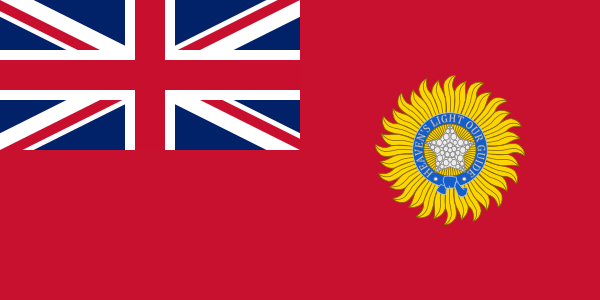
Play as · Cold War 1947 · L1 · Colony on the Eve of Partition
British India - 1947
British India in 1947 is the largest colony on earth in its final weeks of existence. Four hundred million people - a fifth of humanity - live under a Raj that has already agreed to leave, and the only questions left are how fast and along which lines. It is a colony that is somehow also a founding member of the United Nations, its delegation seated in New York since 1945 while it was still governed from London, a great power in demographic and economic weight with almost no sovereign agency of its own. Lord Mountbatten has arrived as the last Viceroy with a mandate to transfer power and a clock running down. The Muslim League demands Pakistan; the Congress wants a united India; the princely states must choose; and beneath the constitutional negotiation, communal violence is spreading from the Punjab to Bengal. The strategic identity is the colossus at the moment of division - a subcontinent of immense potential and no settled shape, about to become one of the largest events in modern history in the space of a single summer.
Starting position
The starting board is a transfer of power in fast motion. On the third of June the plan is announced: British India will be partitioned into two dominions, India and Pakistan, and power handed over on the fifteenth of August - a timetable of ten weeks for the division of a fifth of the human race. A boundary commission under Cyril Radcliffe is drawing lines through the Punjab and Bengal that almost no one will see until after independence. The 565 princely states, technically free to accede to either dominion or to neither, are being pressed to choose. The army, the railways, the treasury, the civil service - the machinery of a continent - must be split. And already the communal killing has begun: in the mixed districts, millions are starting to move, and the greatest forced migration in history is gathering. The Raj still governs, but it governs a house it has agreed to demolish, holding order barely, with too few troops and no political authority left to spend.
What turns the campaign
What the departing power wants is to leave without a war on its hands and without the transfer collapsing into chaos it will be blamed for. What Congress wants is a strong, united, independent India; what the League wants is a sovereign Pakistan; and the tragedy of 1947 is that these cannot all be had, and the compromise - partition on a brutal timetable - satisfies no one and costs enormously. The campaign turns on the questions the summer decides: where the lines fall, which states accede where, whether the communal violence can be contained or explodes into the massacres and the exodus that in fact killed hundreds of thousands and displaced perhaps fifteen million. Beyond independence lies the shape of the new states themselves - India's choice of non-alignment between the emerging blocs, the unresolved fate of Kashmir, the sheer task of governing a subcontinent. In this year the colony is already a UN member with a foot in the world's councils and no control over the events about to remake it.
Signature challenge
A fifth of humanity, dividing in ten weeks
British India's central strategic condition is that it is simultaneously one of the most important entities on earth and one with almost no sovereign agency at the moment it matters most. It has the seat at the United Nations, the population of a superpower, the economic base of a great state - and it is being administered by a departing viceroy on a countdown, its shape decided in negotiations it barely controls. NationFall surfaces this as the campaign's defining tension: enormous latent power held in a colonial frame that is dissolving, where the decisive moves are not military or industrial but constitutional and communal - the accession of a princely state, the drawing of a district's boundary, the containment or the failure to contain a riot. The player inherits the eve of the largest partition in history and the birth of the world's largest democracy in a single motion, and must navigate a transfer of power in which the greatest achievement and the greatest catastrophe are separated by only a few weeks and a few lines on a map.
Try the British India campaign
Free demo. Pick Cold War. Pick British India. Steer a fifth of humanity through partition.
Play Free Demo as British IndiaRegional: the Republic of China · Ceylon · British Burma - see the Cold War 1947 scenario hub
British India across the eras