

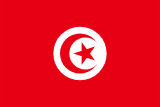
Play as · WW3 2026 · L1 · Post-Arab-Spring Reversal
Tunisia - 2026
Tunisia is governed by Kais Saied - the constitutional-law professor turned president who, since the July 25, 2021 self-coup that suspended parliament and dismissed the government, has progressively concentrated political power, rewritten the constitution through a 2022 referendum, and produced the most thoroughgoing institutional-political reversal of any Arab Spring state. Population about 12.4M, GDP around $170B PPP. The country has been in IMF-program negotiations since 2022 without reaching final agreement (Saied has publicly rejected the conditionality the staff-level negotiated in late 2022), the EU-Tunisia migration cooperation memorandum of July 2023 has been the principal external-relationship-financing arrangement, and the Mediterranean migration corridor through Tunisia has been the central foreign-policy pressure-point with European partners.
Starting position
The Tunisian Armed Forces are about 36,000 active personnel, with the National Guard adding another substantial paramilitary component, oriented toward border defense (the Algerian and Libyan frontiers, particularly the Libyan-side jihadist-and-criminal-network pressures), counter-terrorism, and internal-security functions. Equipment is mixed and aged with selected modernization through US, Italian, and Algerian cooperation. The fiscal-and-economic situation has been chronically constrained - the absence of an IMF program has limited multilateral financing, the bilateral arrangements (EU migration deal, Saudi and other Gulf-state engagement, Algerian energy cooperation) have provided rolling-but-limited liquidity, and the foreign-exchange-reserves trajectory has been the central concern.
What turns the campaign
What Tunisia under Saied wants is the political-institutional consolidation completed through the constitutional and electoral framework the post-2021 reforms have established, the IMF program negotiated on terms that the political position can accept (the staff-level conditionality has been rejected; alternative arrangements have not materialized at scale), the EU migration cooperation maintained at the financial scale the July 2023 agreement promised, the Algerian energy and fiscal cooperation deepened against the periodic stress, and the political opposition contained through the legal-and-institutional instruments rather than the more confrontational approaches that international human-rights organizations have continuously documented. What Tunisia fears is an IMF program collapse that produces a sovereign-debt crisis, an EU migration cooperation reversal under European political-political pressure, and a domestic political-economic crisis that the security-emergency politics has been able to manage but that the underlying fiscal-and-social conditions could amplify beyond containment.
Signature challenge
The Arab Spring birthplace, reversed
Tunisia's central strategic problem is sustaining the Saied authoritarian consolidation in an economic-and-fiscal environment that the post-2010 constitutional-democratic period had not stabilized either, and in an international environment where the European partners' tolerance for the political reversal has been continuously calibrated against the migration-cooperation requirements that Saied's government delivers on. The 2010-11 revolution that produced the broader Arab Spring originated in Tunisia and was the only one to substantively produce a transitional constitutional-democratic period; the 2021-onwards reversal has been the most explicit demonstration that the original transition's institutional gains were not durable. NationFall surfaces this as the Tunisian campaign's defining tension: a state whose recent political history bracketed the rise and reversal of Arab-Spring-era constitutional democracy, played out in an economic environment where neither institutional configuration produced the social-economic outcomes the political consensus has assumed.
Try the Tunisia campaign
Free demo. Pick WW3. Pick Tunisia. The Arab Spring birthplace, reversed.
Play Free Demo as Tunisia