

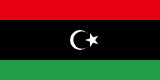
Play as · WW3 2026 · L1 · Divided State · Oil
Libya - 2026
Libya remains divided between two governing centers - the Tripoli-based Government of National Unity under Abdul Hamid Dbeibeh, internationally recognized but operating with substantially reduced legitimacy after the 2024 institutional collapse around Bashagha-aligned political maneuvers, and the Tobruk-Benghazi-based House of Representatives aligned with the Libyan National Army under Field Marshal Khalifa Haftar. Population about 7M, GDP around $140B PPP. The country's oil sector - the principal economic asset, with reserves at the largest in Africa - has been operationally divided between the two sides through the post-2014 collapse, with periodic National Oil Corporation reunification attempts and continuing production-distribution disputes. The strategic identity is the post-Gaddafi state-failure case - fifteen years after the 2011 NATO intervention that ended the Gaddafi government, Libya remains the most-explicit case of the post-intervention reconstruction failure.
Starting position
Libya's military situation has been the central political-strategic question of the post-2011 period. The GNU-aligned forces in the west include the post-2014 western militias (the al-Bunyan al-Marsus alliance evolved into the LNA-opposed coalition), Turkish military advisors and Bayraktar TB2 deployments, and the Italian-led EUNAVFOR MED IRINI naval mission's coastal-cooperation. The LNA in the east has been substantially Russian-aligned through the Wagner-now-Africa-Corps presence - about 1,500 Russian personnel concentrated at the al-Khadim airfield and the Brak al-Shati base, plus the broader logistics-and-training architecture that the Africa Corps has institutionalized. The oil installations have been periodically blockaded, contested, and reopened across the post-2014 period.
What turns the campaign
What both Libyan governing centers want, in different configurations, is the political-territorial-institutional reunification on terms favorable to their respective coalitions, the oil revenue distributed through arrangements that respect the territorial control patterns, and the international recognition consolidated. What the GNU specifically wants is the Turkish security architecture preserved, the Italian and broader European migration cooperation maintained, and the constitutional process advanced. What the LNA-HoR specifically wants is the Russian Africa Corps presence preserved, the eastern oil revenues fully retained, and the constitutional process structured to legitimize the Haftar-political-institutional position. What both sides fear is a renewed direct military confrontation on the 2019-20 scale (the LNA's Tripoli offensive that produced major Turkish intervention), an Egyptian or Algerian military move that would substantially recalibrate the regional balance, and an oil-installation crisis that disrupts the revenue flow that keeps both political-economies functional.
Signature challenge
The fifteen-year state-failure
Libya's central strategic problem is that the post-2011 state-failure has been continuous for fifteen years, the international-and-regional actors invested in resolving it have been unable to converge on a framework that the Libyan parties themselves can sustain, and the underlying institutional-political damage to Libyan state capacity has compounded faster than any reconstruction effort has been able to address. NationFall surfaces this as the Libyan campaign's defining tension: a North African state whose oil-and-strategic-real-estate value is genuinely consequential to the European Mediterranean, the Russian Africa-strategy, and the broader regional politics, and whose internal political reconstruction has resisted every external framework attempted since 2011 - Skhirat, Berlin, the post-2020 ceasefire architecture, the post-2024 institutional renegotiations.
Try the Libya campaign
Free demo. Pick WW3. Pick Libya. Divided state. Russian east. Italian-Turkish west. Oil at the center.
Play Free Demo as Libya