

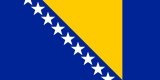
Play as · WW3 2026 · L1 · EU Candidate · Dayton State
Bosnia and Herzegovina - 2026
Bosnia and Herzegovina is the constitutional architecture left behind by the 1995 Dayton Peace Agreement - a federal state with two entities (the Federation of Bosnia and Herzegovina, the Republika Srpska), three constituent peoples (Bosniaks, Croats, Serbs), a tripartite presidency, and an Office of the High Representative with executive powers held over from the post-war supervision. Population 3.2M, GDP around $70B PPP, EU candidate since December 2022, accession negotiations opened March 2024. The strategic identity is the Western-Balkan post-conflict state whose post-conflict architecture is increasingly contested by the Republika Srpska leadership under Milorad Dodik, who has spent fifteen years testing the limits of what secession-adjacent rhetoric and legislation the international community will tolerate.
Starting position
The Armed Forces of Bosnia and Herzegovina were unified by the 2005 Defence Reform Law that consolidated the previous entity-based forces - about 9,000 active personnel, organized in three brigades that retain ethnic identity at the unit level (Bosniak, Croat, Serb) but operate under unified command. Equipment is mixed and aged. The country participates in NATO's Partnership for Peace but the Membership Action Plan was activated in 2018 and effectively suspended in 2019 over Republika Srpska political opposition. EUFOR Althea - the EU's military mission, a successor to the NATO SFOR mission - maintains about 1,100 troops with executive Chapter VII mandate and was reinforced in 2022 to deter the secessionist trajectory. The Office of the High Representative under Christian Schmidt continues to use Bonn Powers to amend laws and remove officials.
What turns the campaign
What Bosnia wants - at the federal level, with caveats from each entity - is the EU accession process advanced through the negotiating chapters now open, the Republika Srpska secessionist trajectory contained without an active confrontation that breaks the federation, the EUFOR Althea mandate renewed (it requires UN Security Council renewal each November, and Russian and Chinese veto threats have made each renewal a sustained crisis), and the constitutional reforms that European Court of Human Rights judgments have repeatedly demanded - Sejdić-Finci and successors - implemented without a referendum that re-opens every Dayton question. What Bosnia fears is a Republika Srpska declaration of independence or de facto withdrawal from federal institutions, a Croatian-Bosnian ethnic-political crisis that destabilizes the federation entity, and a UN Security Council failure to renew EUFOR that removes the deterrent presence.
Signature challenge
The Dayton ceiling
Bosnia's central strategic problem is that the Dayton Agreement that ended the war also constitutionalized the ethnic divisions that produced it - every state institution operates by ethnic-key power sharing, the Republika Srpska entity has structural veto power over federal decisions, and the architecture cannot be reformed without amending Dayton, which requires the unanimous consent of the actors whose veto power is the central problem. NationFall surfaces this as the Bosnian campaign's defining tension: a state whose foundational document is also its central obstacle, played against a Republika Srpska leadership that has converted the obstacle into political asset, an international community whose enforcement instruments (Bonn Powers, EUFOR) are increasingly contested, and an EU accession that demands reforms the constitutional architecture cannot accommodate.
Try the Bosnia and Herzegovina campaign
Free demo. Pick WW3. Pick Bosnia. Three peoples, two entities, one impossible federation.
Play Free Demo as Bosnia and HerzegovinaRegional: Croatia · Serbia · Montenegro