

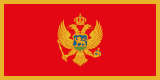
Play as · WW3 2026 · L1 · NATO Adriatic
Montenegro - 2026
Montenegro is NATO's penultimate accession (2017, before North Macedonia 2020) and the EU candidate with the most advanced accession negotiations in the Western Balkans - most chapters opened, several provisionally closed. Population 600,000, GDP around $15B PPP. The economy is unilaterally euroized - Montenegro uses the euro without being a eurozone member, a legacy of the post-Yugoslav transition that has resisted every IMF and ECB attempt to regularize. The strategic identity is the Adriatic micro-state that walked away from a Belgrade-led union in 2006, joined NATO in the face of an attempted Russian-backed coup in 2016, and has spent the years since converting that political-strategic alignment into operational capability.
Starting position
The Armed Forces of Montenegro are about 2,400 active personnel - among the smallest militaries in NATO - organized as one infantry battalion, an air force of helicopters and a few light aircraft, and a navy oriented around two large patrol vessels (the former Yugoslav Kotor-class) plus smaller craft. Equipment is mostly Yugoslav-successor stock with selective modernization. The country participates in NATO's Resolute Support Mission successor and contributes a small detachment to KFOR. The Bay of Kotor - the deep, fjord-like Adriatic anchorage that was a Yugoslav naval base - is the geographic asset; its disposal post-independence has been controversial (Tivat Marina, the Porto Montenegro luxury development on the former naval base site, is the visible symbol of the post-strategic conversion).
What turns the campaign
What Montenegro wants is the EU accession completed within the decade - currently the only Western Balkan candidate with a credible near-term horizon - the NATO posture maintained against the Russian-aligned political opposition that has periodically gained influence (the 2020 election that ended thirty years of DPS rule, the subsequent coalition instability), the Bay of Kotor and Adriatic coastal infrastructure preserved against the Russian-and-Serbian-aligned investment that has periodically been proposed, and the Serbian-Orthodox-Church political role in Montenegrin politics managed without re-opening the 2006 independence question. What Montenegro fears is a domestic political swing that reverses the NATO and EU trajectory, a Russian-backed information or political operation more sophisticated than the 2016 coup attempt, and a Serbian government that converts the Republika Srpska crisis in Bosnia into a regional Serbian-nationalist mobilization that touches Montenegrin politics.
Signature challenge
The micro-state alliance member
Montenegro's central strategic problem is that joining the alliance was easier than sustaining the political consensus the alliance membership was supposed to anchor - the 2017 NATO accession was passed in the Montenegrin parliament without referendum amid significant opposition, the 2016 coup attempt by Russian intelligence and Serbian nationalist activists demonstrated the lengths the opposition was prepared to go, and the political system has since spent years working through coalitions with Russian-and-Serbian-aligned components. NationFall surfaces this as the Montenegrin campaign's defining tension: a small state whose alliance membership is real and whose alliance commitments are intact, played out against a domestic political environment in which the case for membership remains continuously contested by actors with external sponsorship.
Try the Montenegro campaign
Free demo. Pick WW3. Pick Montenegro. Smallest army in NATO, most contested membership.
Play Free Demo as Montenegro