

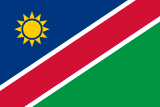
Play as · WW3 2026 · L1 · Walvis Bay · Green Hydrogen
Namibia - 2026
Namibia is governed by Netumbo Nandi-Ndaitwah of SWAPO - sworn in March 2025 as the country's first female head of state, succeeding the late Hage Geingob and continuing the SWAPO governing continuity since the 1990 independence from South African rule. Population about 2.6M, GDP around $30B PPP. The strategic identity is the energy-transition emerging state with the offshore oil-and-gas discoveries (the Venus discovery operated by TotalEnergies and Galp at the Block 2913B consortium, the Graff discovery operated by Shell, the broader Orange Basin pre-salt formation that geological assessments have positioned as among the largest African discoveries of the past decade), the substantial green-hydrogen investment positioning (the Hyphen Hydrogen Energy and other Western-aligned investments at the Tsau //Khaeb National Park area), and the Walvis Bay strategic-port positioning that has been progressively developed for both commercial and military strategic uses.
Starting position
The Namibian Defence Force is about 9,000 active personnel, oriented toward border defense, internal security, and limited regional-cooperation deployments. Equipment is mixed and modest. The offshore oil-and-gas discoveries are progressing through appraisal and final-investment-decision phases - Venus is targeted for first oil around 2030, Graff has had additional appraisal commitments. The green-hydrogen architecture has been the most-distinctive Western-aligned strategic-economic positioning the country has developed - the Hyphen project at $10B-plus headline value targets export-scale ammonia production for European markets, with substantial German and EU policy-and-financing support. The Walvis Bay port development has been a joint China-Namibia infrastructure project alongside the broader Western-aligned engagement.
What turns the campaign
What Namibia under Nandi-Ndaitwah wants is the SWAPO political-institutional continuity preserved through the post-Geingob transition that the new presidency represents, the offshore oil-and-gas discoveries operationalized at the projected scale and the revenue distribution institutionalized to avoid resource-curse pathologies, the green-hydrogen project advanced from political-architecture to operational delivery, the Walvis Bay strategic-port development balanced between Chinese-and-Western-aligned engagement, the SADC regional-cooperation deepened under the new administration, and the post-1994 land-reform and broader social-economic justice agenda advanced through whatever institutional framework the post-Geingob political consensus can sustain. What Namibia fears is an oil-and-gas project setback that delays the strategic-economic transformation, a green-hydrogen political-economic crisis if the Western financing or demand environment shifts, and a SWAPO internal-political crisis that the post-Geingob succession has been able to navigate but that the longer-horizon institutional questions could amplify.
Signature challenge
The energy-transition emerging state
Namibia's central strategic problem is converting the multi-dimensional energy-transition strategic-economic positioning (offshore oil-and-gas discoveries, green-hydrogen export architecture, critical-minerals mining, the Walvis Bay strategic-port development) into operational delivery and revenue distribution that the small-state institutional capacity can absorb without producing the resource-curse pathologies that comparator African petro-states have demonstrated. The Nandi-Ndaitwah presidency is the post-Geingob political-institutional continuity; the strategic-economic transformation is the multi-decade question. NationFall surfaces this as the Namibian campaign's defining tension: a southern African small state whose strategic-economic potential has expanded substantially across multiple energy-transition dimensions, played out against the institutional-capacity and political-economic-distribution challenges that any resource-rich emerging state faces.
Try the Namibia campaign
Free demo. Pick WW3. Pick Namibia. Energy-transition emerging state. Walvis Bay. Green hydrogen.
Play Free Demo as NamibiaRegional: South Africa · Botswana · Angola