

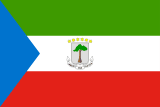
Play as · WW3 2026 · L1 · Obiang Continuity · Hispanic Africa
Equatorial Guinea - 2026
Equatorial Guinea is governed by Teodoro Obiang Nguema Mbasogo - in continuous power since the August 1979 coup that overthrew his uncle Francisco Macías Nguema, making him the longest-serving non-royal head of state in the world at 47 years and counting. Population about 1.6M, GDP around $30B PPP. The country is the only Spanish-speaking African state - the post-1968 independence from Spain having institutionalized the Spanish-language and broader Hispanic-cultural identity that the Lusophone, Anglophone, and Francophone African comparators do not share. The strategic identity is the closed Hispanic-African petro-state with the Obiang-family-political-institutional consolidation, declining production after a mid-2000s petroleum peak, and the unitary state’s difficult Bioko-Río Muni-Annobón geography.
Starting position
The Equatorial Guinea Armed Forces are about 2,500 active personnel - small relative to the substantial petro-state revenue that the post-1995 oil-and-gas era has produced - oriented toward border defense, internal security (substantially documented human-rights concerns), and limited regional-cooperation deployments. Equipment is mixed and modest. The post-1995 oil-and-gas sector has been the principal economic driver, with petroleum liquids peaking in 2005 and declining since. ExxonMobil transferred its Zafiro Block B interests to state company GEPetrol in June 2024, while ConocoPhillips acquired Marathon Oil in November 2024. Those changes put operating capacity and contract oversight at the centre of energy policy. The Vice Presidency, held since 2016 by Teodoro Nguema Obiang Mangue (Teodorín, the President's son) has been the institutional-political architecture for the eventual succession question.
What turns the campaign
What Equatorial Guinea under Obiang wants is the political-institutional continuity preserved through whatever succession arrangement the closed system can produce (the Teodorín-positioning is the central architecture), the oil-and-gas production decline managed through fiscal consolidation and the gas-export development (the LNG production from the Punta Europa complex), the regional-cooperation through CEMAC preserved at whatever level the Central African political-economic environment supports, the Spanish-and-broader-EU bilateral relationships preserved against the periodic stress that the human-rights-and-corruption-prosecution issues have produced, and a practical United States relationship maintained around energy, maritime security and consular interests. What Equatorial Guinea fears is an oil-revenue collapse beyond fiscal-consolidation capacity, an Obiang succession crisis if the Teodorín-positioning produces internal-political contestation, and a Western-coordinated pressure response if the human-rights-and-corruption issues produce the kind of sanctions-architecture that has periodically been threatened.
Signature challenge
The Hispanic-African petro-state continuity
Equatorial Guinea's central strategic problem is preparing for political and fiscal transition while the current system rewards delay. Teodoro Obiang’s rule since 1979 and the prominence of Vice-President Teodoro Nguema Obiang Mangue make succession a family, military and constitutional question at once. Hydrocarbon output has fallen from its peak, so lavish infrastructure cannot substitute indefinitely for reliable water, electricity, schools and clinics. The campaign should publish production-sharing revenue, audit state companies, maintain the Punta Europa gas complex and fund a budget that survives a lower price. Geography complicates every choice. A January 2026 decree made Ciudad de la Paz the legal capital and allowed a one-year relocation period, so institutions must move without implying that every ministry and service has already left Malabo. Bioko, Bata and Río Muni, Annobón and smaller islands need transport and representation that do not depend on proximity to the presidency. CEMAC membership ties reserves and fiscal rules to neighbours, while maritime boundaries and Gulf of Guinea piracy require practical cooperation. Spanish language and historical ties broaden diplomacy, but corruption cases and human-rights concerns constrain Western partnerships. China, Russia and other suppliers offer alternatives without removing the need to compare terms. NationFall makes the defining tension concrete: use the remaining petroleum cushion to build impartial institutions and non-oil livelihoods before leadership uncertainty and declining fields arrive together. Personal continuity can postpone a decision; it cannot finance or legitimate the state after the underlying conditions change. Health and education indicators remain the clearest test of whether hydrocarbon wealth became public capacity. Maintain clinics on islands and the mainland, publish medicine stocks, and train staff without tying appointments to factional loyalty. Small businesses need electricity, predictable customs and access to credit more than another showcase project. An orderly leadership transition requires an election calendar, independent counting and command rules accepted before a vacancy. These measures cannot erase repression’s legacy, but they give officials and citizens reasons to defend institutions rather than seek protection from rival patrons. Publish municipal transfers as well, so residents can test whether national revenue reaches Bioko, Río Muni and Annobón under the same rules.
Try the Equatorial Guinea campaign
Free demo. Pick WW3. Pick Equatorial Guinea. Hispanic Africa. Obiang continuity.
Play Free Demo as Equatorial GuineaRegional: Cameroon · Gabon · São Tomé
Equatorial Guinea across the eras