

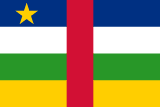
Play as · WW3 2026 · L1 · Touadéra · Russian Africa Corps
Central African Republic - 2026
The Central African Republic is governed by Faustin-Archange Touadéra - confirmed for a second term in the December 2023 election (with substantial post-July-2023-constitutional-referendum political-institutional reform that removed term limits) - and the country whose post-2018 Russian Africa Corps (formerly Wagner Group) cooperation has been the principal external-security partnership since the broader French-engagement compression. Population about 5.5M, GDP around $5B PPP. The strategic identity is the post-2013-civil-war Russian-aligned Central African petro-state - CAR's strategic-political reorientation has been the most-explicit Russian-aligned Central African positioning, the mining-sector cooperation has produced substantial Russian-aligned operations particularly in the gold and diamond sectors, the United Nations MINUSCA mission continues as the residual peacekeeping framework, and the broader regional-cooperation through ECCAS and CEMAC has been continuously challenging.
Starting position
The Central African Armed Forces are about 12,000 active personnel - substantially restructured across the post-2013-civil-war reconstruction period and supplemented by the Russian Africa Corps presence (about 1,500 personnel at recent reporting). Equipment is mixed and modest. The Russian Africa Corps cooperation has been the principal external-security partnership since 2018, with the Russian instructors-and-mining-companies framework having institutionalized the bilateral relationship. The MINUSCA UN peacekeeping mission has continued at substantial scale (about 14,000 personnel) but with the operational-effectiveness-and-coordination challenges that the multi-actor security-environment has produced. The post-Khartoum-2019 disarmament-agreement framework has been incompletely implemented; the post-2020 anti-government rebel-coalition CPC was substantially defeated through the post-2020 escalated security operations.
What turns the campaign
What CAR under Touadéra wants is the post-2023-election political-institutional consolidation preserved through the second term, the Russian Africa Corps cooperation deepened at the operational scale the security situation requires, the mining-sector cooperation (gold, diamonds, uranium-prospects) advanced at the level the Russian-aligned framework can deliver, the MINUSCA UN mission preserved at whatever level the post-renewal political environment supports, the regional-cooperation through ECCAS and CEMAC sustained against the periodic stress of CAR's distinctive Russian-aligned positioning, and the rebel-coalition fragmentation continued through whatever combination of military operations and political-disarmament processes can be sustained. What CAR fears is a Russian Africa Corps drawdown if the strategic-budget reprioritizes, a renewed rebel-coalition offensive that exceeds containment capacity, a MINUSCA withdrawal that removes the residual UN-peacekeeping framework, and a regional Central African crisis (Sudan civil war spillover, Chad continuing instability, broader CEMAC political-economic pressures) that exceeds the limited institutional capacity.
Signature challenge
The Russian-aligned Central African petro-state
CAR's central strategic problem is sustaining the Touadéra-era political-institutional architecture and the Russian-aligned security cooperation in a regional environment where the comparator Sahel-juntas have institutionalized similar positioning at scale, the mining-sector cooperation has produced strategic-economic outcomes that have not been distributed at scales the broader population can substantively benefit from, and the institutional-state-capacity continues to be among the most-constrained in the African comparative-governance metrics. The Russian-aligned positioning is the most-distinctive Central African foreign-policy framework; the post-2013-civil-war reconstruction is the multi-decade institutional project; the regional-environment crisis is the increasingly-acute external context. NationFall surfaces this as the Central African campaign's defining tension: a fragile-state petro-positioning whose post-2018 Russian-aligned reorientation has been substantively delivered, played out in an institutional-capacity environment where the alternative external-engagement (Western, broader regional) has been progressively compressed.
Try the Central African Republic campaign
Free demo. Pick WW3. Pick Central African Republic. Touadéra. Russian Africa Corps. Post-2013 reconstruction.
Play Free Demo as Central African Republic