

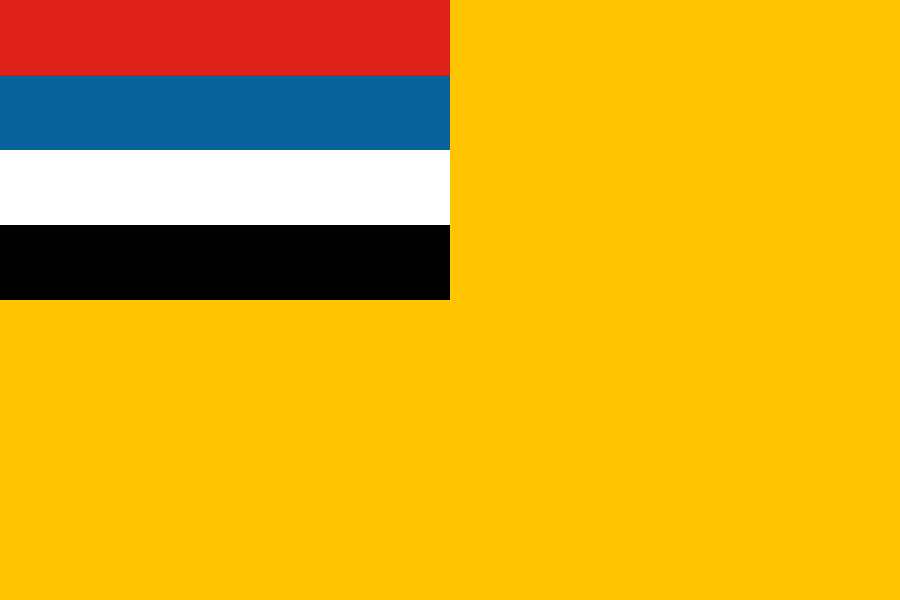
Play as · WW2 1939 · L2 · Axis (Japanese client)
Manchukuo - 1939
Manchukuo in 1939 is the Japanese client state established in 1932 from the territory of former Chinese Manchuria following the September 1931 Mukden Incident. Puyi, the last Qing emperor, serves as the nominal emperor since 1934 (previously Chief Executive); operational sovereignty rests entirely with the Kwantung Army of the Imperial Japanese Army, which uses Manchukuo as the staging area for the Sino-Japanese War, the heavy-industrial-development project under Japanese state-corporate planning, and the strategic frontage against the Soviet Union and Mongolia. Population is around 35 million (mostly Han Chinese with significant Manchu, Korean, and Japanese settler minorities); the economy is the largest non-Japanese heavy-industrial base in Asia.
Starting position
The strategic test for Manchukuo in 1939 is the Battles of Khalkhin Gol (May-September 1939), where Japanese-Manchukuo forces fight Soviet-Mongolian forces under Zhukov on the Mongolia-Manchukuo border in what becomes the largest tank battle to date and the decisive Soviet victory that pushes Japanese strategic planning away from the 'Strike North' option (war with the USSR) and toward the 'Strike South' option (Pacific war against the US, UK, and the Dutch East Indies oil) that 1941 will deliver. Manchukuo through 1939-45 supplies coal, iron, steel, machinery, and grain to the Japanese war economy at scales no other Co-Prosperity Sphere territory matches. The Kwantung Army garrisons substantial forces - 700,000-plus at peak - until the late-war transfers to the Pacific deplete the formation. The August 8-22, 1945 Soviet invasion (Operation August Storm) destroys the remaining Kwantung Army and ends the state in eleven days.
What turns the campaign
What Manchukuo's Japanese sponsors want is the heavy-industrial development converting the territory into the Co-Prosperity Sphere's principal economic base, the Kwantung Army's frontage against the Soviet Union deterring Soviet entry into the Pacific war (achieved through the April 1941 Japanese-Soviet Neutrality Pact, breaks down in August 1945), and the puppet-state framework demonstrating the East Asian alternative to European colonial models that Pan-Asian propaganda emphasizes. What Manchukuo experiences is the heavy industrial extraction prioritized over civilian welfare, the Han majority population's continuous resistance through bandit and partisan operations, the systematic atrocities of Unit 731's biological warfare experimentation at Pingfang outside Harbin, and the Soviet 1945 invasion that destroys the state structure in days as the Japanese collapse exposes the puppet-state's inability to function autonomously.
Signature challenge
The puppet-state-as-industrial-base problem
Manchukuo is the Japanese empire's most ambitious state-construction project - a heavy-industrial economy built from scratch in thirteen years on territory that 1931 propaganda framed as a Manchu national restoration and 1945 reality exposed as Japanese imperial extraction. Every institution of the state - the army, the civil service, the industries, the railways - collapsed within weeks of the Soviet invasion because none of them had been built to function without Japanese direction. NationFall surfaces this as the chronic puppet-state question: a client polity that cannot function autonomously is exactly as durable as the patron's military presence, and not one day longer.
Try the Manchukuo campaign
Free demo. Pick WW2. Pick Manchukuo. Industrial base, puppet sovereignty, eleven-day end.
Play Free Demo as ManchukuoRegional: Japan · USSR · Nationalist China · Korea